Blood Sugar · 3 min read
Blood Sugar After 40: Why You Crave Sugar at 3pm and Feel Tired All Day
Feeling tired and craving sugar in the afternoon is common after 40, and blood sugar can be one part of the story. Here is what the research says, what you can test this week, and when to talk to your doctor.

Feeling tired and reaching for sugar mid-afternoon is common after 40, and it rarely has just one cause. Blood sugar can be part of the picture, but so can sleep, stress, how much protein you eat, and long gaps between meals. The good news: you can test simple changes without tracking everything.
What "blood sugar" actually means
When you eat, the carbohydrates in your food are broken down into glucose, and the level of glucose in your blood rises, then falls again. That rise and fall is normal. It is not a sign that something is wrong with you. A mid-afternoon dip in energy does not automatically mean a "crash," and plenty of women feel flat at 3pm for reasons that have nothing to do with glucose.
That rise and fall is normal. It is not a sign that something is wrong with you.
Why midlife can feel different
Around the menopause transition, research following hundreds of women found that fat gain roughly doubled and lean mass began to decline, even though total weight changed little (Greendale et al., JCI Insight, 2019). Muscle is one of the main places your body uses glucose, so protecting it is a sensible goal. Sleep often gets lighter in perimenopause too, and a tired body tends to ask for quick energy. None of this is a character flaw. It is a changing body asking for a changing plan.
When I started paying attention, the biggest change was that my afternoon slumps went away. No more needing a nap at 2:00, or reaching for coffee or something sugary to get my energy back. For me, starting the day with breakfast and eating regularly through the day is what keeps that slump from showing up.
Five low-effort experiments to try
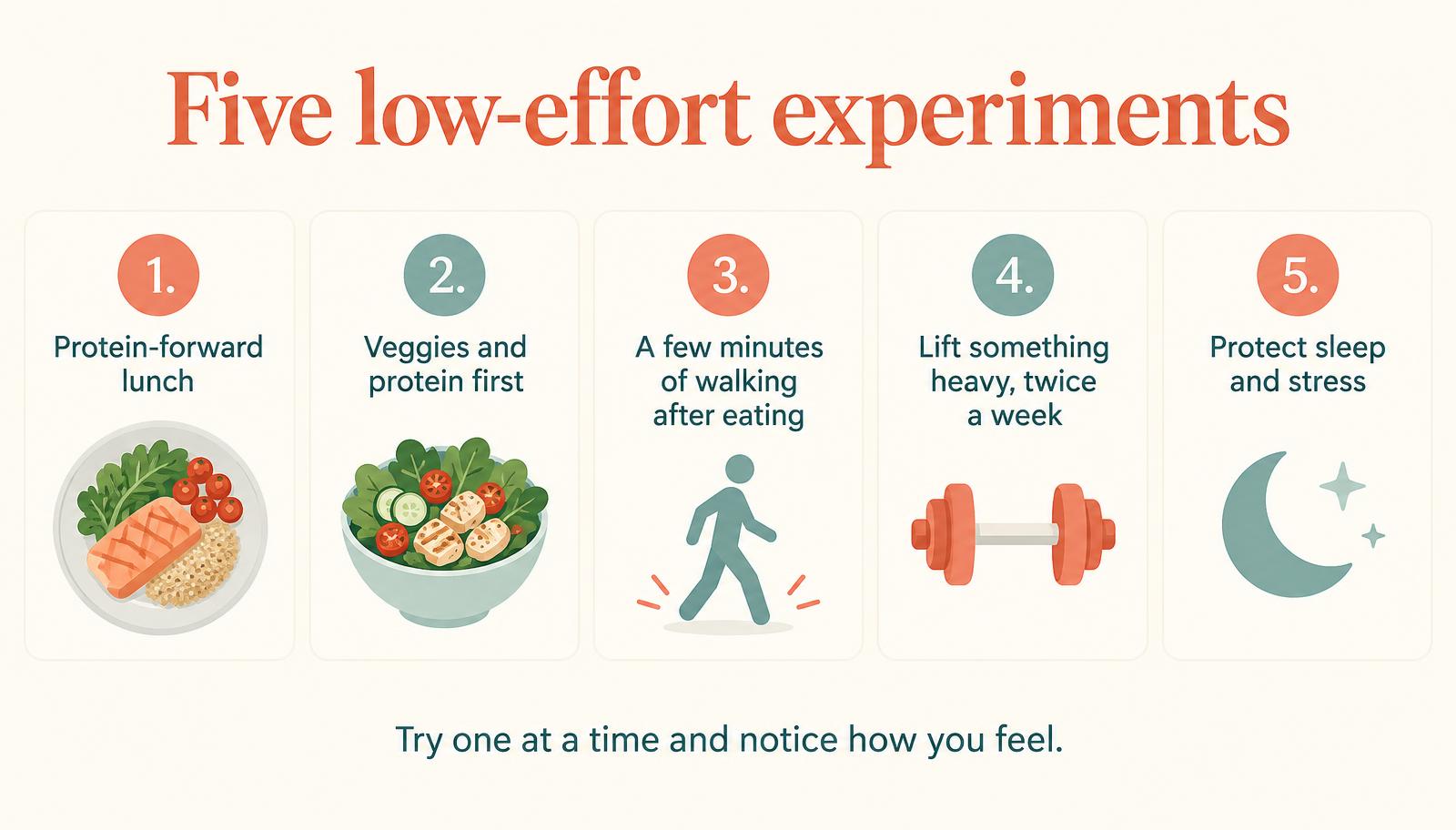
- Build a protein-forward lunch. Notice whether your 3pm changes over a week. Protein with meals is a foundation of the Boost Lab approach, and it is easy to test.
- Try food order. In a small study of 11 adults with type 2 diabetes, eating vegetables and protein before carbohydrates produced lower blood sugar after the meal than eating the carbohydrates first (Shukla et al., Diabetes Care, 2015). A later study in 15 people with prediabetes saw a similar pattern. These studies are small, so treat food order as something to try, not a guarantee.
- Move for a few minutes after eating. A 2022 meta-analysis found that breaking up sitting with short bouts of light walking lowered blood sugar after meals compared with continuous sitting (Buffey et al., Sports Medicine, 2022).
- Lift something heavy, twice a week or more. Strength training is how you protect and build the muscle that midlife tends to take.
- Protect your sleep and your stress. They are not glamorous, but they shape appetite and energy every day.
Do you need a continuous glucose monitor?
No. A CGM is a sensor that shows glucose readings through the day. A 2026 review in JAMA Internal Medicine found no evidence that CGMs improve health or prevent disease in people without diabetes, and warned that normal ups and downs are easy to overinterpret (Dower et al., JAMA Internal Medicine, 2026). Some women still find one useful as a short-term learning tool. Read our guide to what a CGM can and can't tell you before deciding.
When to talk to your doctor
Constant fatigue, very strong thirst, needing to urinate much more than usual, blurry vision, unexplained weight changes, or a family history of diabetes are all reasons to ask your doctor about blood sugar testing. If you are on any medication that affects blood sugar, check with your doctor before changing how you eat or exercise.
The bottom line
You do not need to track every number to feel more even through the day. Pick one experiment, run it for a week, and notice what changes. If you want a guided plan built around your own data, that is exactly what the Boost Lab is for.
Listen
Hear Simone talk about this on the podcast

Episode 6 · 9 min
Let's Get Off The Blood Sugar Roller CoasterEpisode 107 · 40 min
The Real Reason You’re Tired, Craving Sugar & Gaining Weight
Frequently asked questions
Is a blood sugar spike after eating always bad?
No. Blood sugar rises after meals in everyone and then comes back down. That is normal. Questions worth raising with your doctor are persistent symptoms such as intense thirst, frequent urination or constant fatigue, not a single reading.
Do I need a CGM to improve my energy?
No. A 2026 JAMA Internal Medicine review found no evidence that CGMs improve health in people without diabetes. Simple experiments with protein, food order, walking and sleep cost nothing.
Can food order alone fix afternoon cravings?
Probably not on its own. The food order studies are small and measured blood sugar after a meal, not cravings. Treat it as one of several things to test alongside protein, movement, sleep and stress.
When should I see my doctor about blood sugar?
If you have constant fatigue, strong thirst, frequent urination, blurry vision, unexplained weight changes, or a family history of diabetes, ask your doctor about testing.
Sources
- Changes in body composition and weight during the menopause transition. JCI Insight, 2019.
- Food order has a significant impact on postprandial glucose and insulin levels. Diabetes Care, 2015.
- The acute effects of interrupting prolonged sitting time with standing and light-intensity walking on biomarkers of cardiometabolic health: a systematic review and meta-analysis. Sports Medicine, 2022.
- Continuous glucose monitoring in type 2 diabetes and beyond: a review. JAMA Internal Medicine, 2026.
More in this guide
Curious what your body needs now?
Take a few minutes to learn which habits could help you most in this season.
Join the Boost Lab waitlistThis is education, not medical advice. Talk to your healthcare provider before changing your nutrition, exercise or medication.