Blood Sugar · 2 min read
What a CGM Can and Can't Tell You If You Don't Have Diabetes
A continuous glucose monitor shows your glucose through the day. Here is what the 2026 JAMA Internal Medicine review found for people without diabetes, how some women use one as a short-term learning tool, and who should skip it.
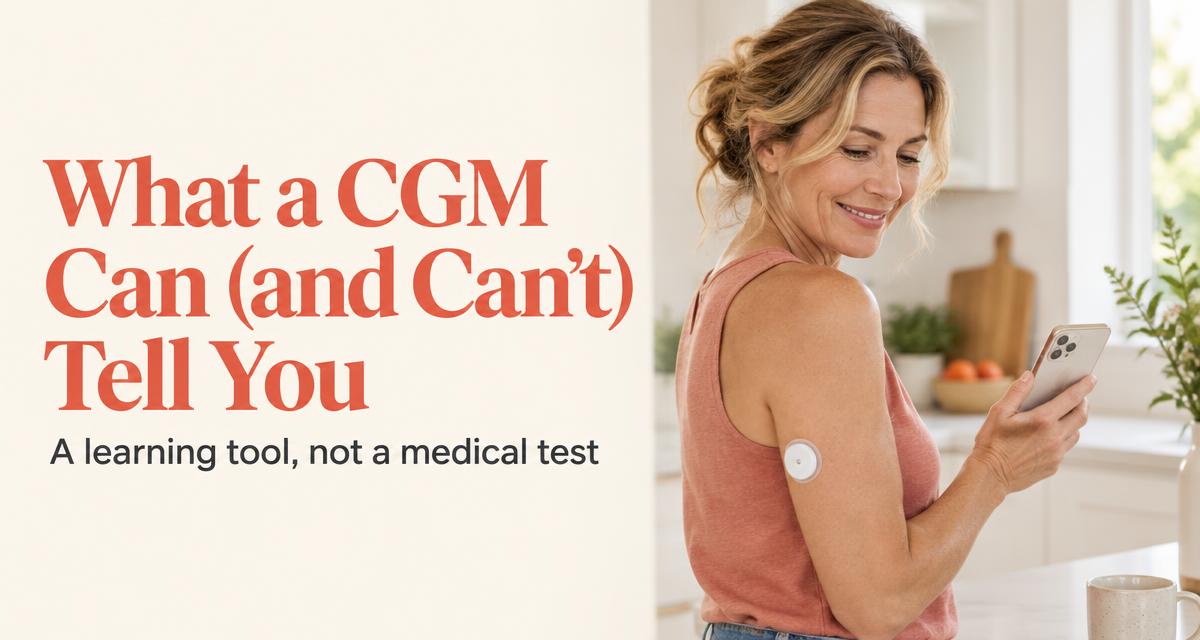
A continuous glucose monitor (CGM) measures the glucose in the fluid under your skin every few minutes, but for people without diabetes there is no evidence yet that wearing one improves health. That was the conclusion of a 2026 review in JAMA Internal Medicine, which also warned that normal ups and downs are easy to overinterpret and can lead to unnecessary food restrictions or anxiety (Dower et al., 2026).
What a CGM measures
A small sensor, usually worn on the back of the upper arm, reads glucose in the fluid between your cells and sends the numbers to an app. You see a line that rises after meals and settles again. That line is real data. What it means for your long-term health, if you do not have diabetes, is still unknown.
What it can't tell you
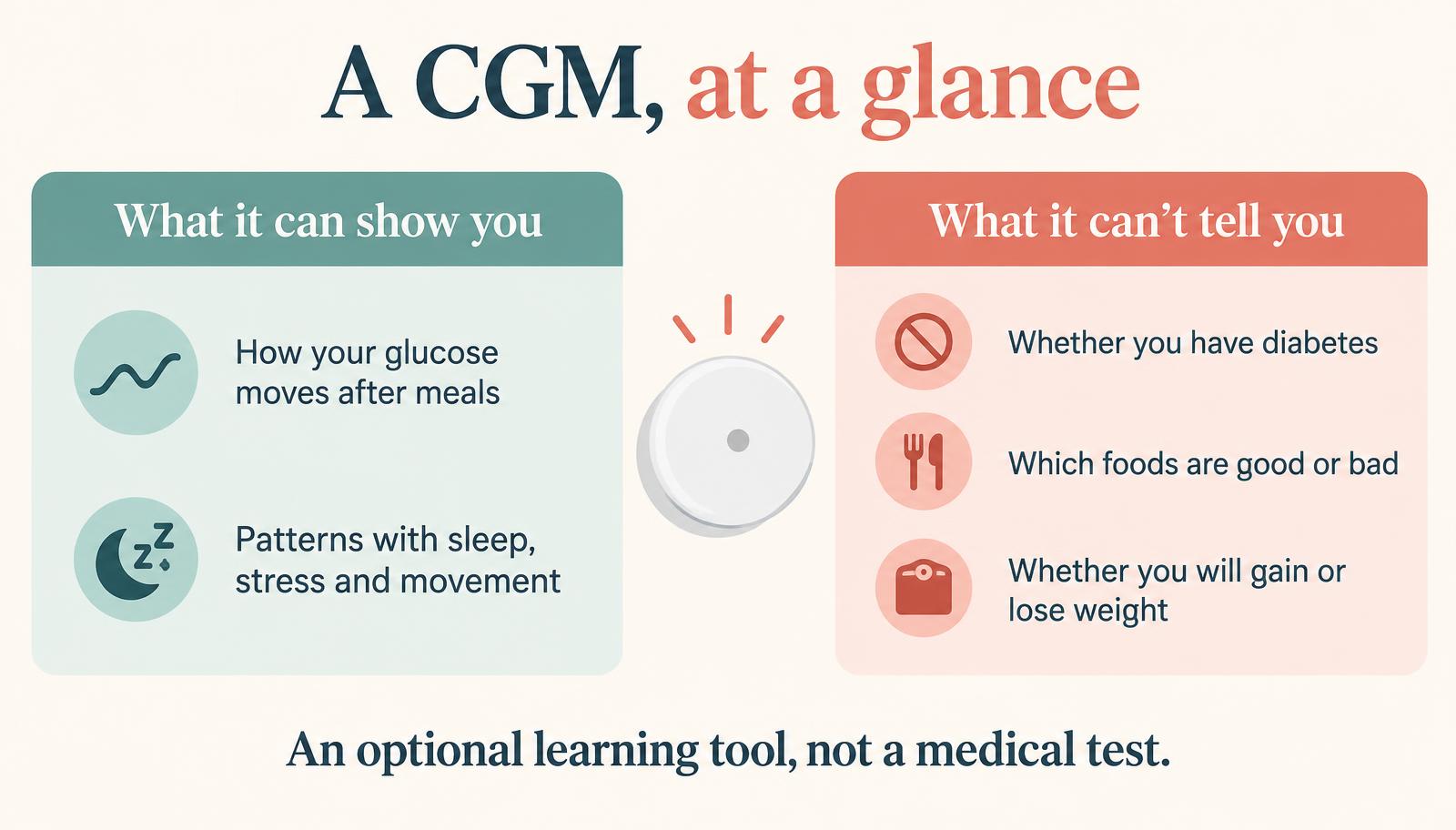
- It is not a diagnostic test. It cannot tell you whether you have diabetes or prediabetes. Your doctor uses blood tests for that.
- It cannot tell you which foods are "good" or "bad." A rise after a meal is normal.
- It cannot predict whether you will gain or lose weight.
A rise after a meal is normal.
Why some women still find one useful
Seeing how a meal, a poor night's sleep or a ten-minute walk shows up on a graph can make habits feel real. That motivation is not the same as a proven health benefit, but it is a fair reason to try one for a short time, as a curiosity tool and not a verdict.
Wearing a CGM gave me a whole new awareness of my own body: which foods made my glucose rise, which ones kept it steadier, and how sleep, stress and movement played in. One of the most eye-opening things was watching what happened when I had caffeine on an empty stomach first thing in the morning. It showed me how much the first choices of the day can shape the rest of it.
If you choose to use one, keep it simple
- Pick one or two questions, such as "How does my usual lunch compare with a protein-forward lunch?"
- Wear it for a short stretch, then stop.
- Compare similar meals and ignore small bumps.
- Do not cut a food out because of one reading.
- Stop if the numbers make you anxious.
Who should talk to a doctor first
Check with your doctor before using a CGM if you have diabetes or prediabetes, take medication that affects blood sugar, or have a history of disordered eating, since constant tracking can feed obsessive habits.
Listen
Hear Simone talk about this on the podcast

Episode 6 · 9 min
Let's Get Off The Blood Sugar Roller Coaster
Frequently asked questions
Do CGMs improve health in people without diabetes?
There is no evidence that they do. A 2026 narrative review in JAMA Internal Medicine found no scientific evidence that CGM use improves health or prevents disease in people without diabetes.
Can a CGM tell me if I have prediabetes?
No. Diagnosis uses blood tests ordered by your doctor. A CGM is not a diagnostic tool.
Is a glucose rise after a meal a problem?
No. Blood sugar rises after meals in everyone and then comes back down. Normal fluctuations are easy to overinterpret.
Who should avoid using a CGM without medical advice?
Anyone with diabetes or prediabetes, anyone on medication that affects blood sugar, and anyone with a history of disordered eating should talk to their doctor first.
Sources
- Continuous glucose monitoring in type 2 diabetes and beyond: a review. JAMA Internal Medicine, 2026.
More in this guide
Curious what your body needs now?
Take a few minutes to learn which habits could help you most in this season.
Join the Boost Lab waitlistThis is education, not medical advice. Talk to your healthcare provider before changing your nutrition, exercise or medication.